Author: comm2676
Contract
COMM2676 Team Contract Template
Team Name: Group 1
Project Topic: Gender stereotypes in AFL
1. Team Purpose
To debunk stereotypes about women in AFLW
3. Team Member Details
| Name | Strengths/Skills | Weaknesses/Challenges | Growth, Learning & New Knowledge | Overall Expectations |
| Annabel | Organisation | Adaptability | Creativity | Participation |
| Chelsea | Reliability | Conflict Resolution | Ability to Work Under Pressure | Commitment |
| Mae | Communication | Procrastination | Teamwork | Teamwork |
| Phoebe | Leadership | Creativity | Adaptability | Recognition |
| Will | Creativity | Decision Making | Communication | Teamwork |
Guys I just wrote random shit in here to fill it in – not my actual opinions on anyone 😛 (Annie)
4. Team Roles
| Name | Project Position Title | Primary Role/s & Responsibilities | Key Tasks |
| Annabel | Resource Investigator | To explore available options, develop contacts. Identify and work with stakeholders to gain internal insights | Research and build connections with project stakeholders |
| Chelsea | Chief Editor | To edit the project’s information with the intention of producing correct, consistent, accurate and complete work | correct, condense and organize project material |
| Mae | Communication Representative | To conduct future class presentations and interviews as the group’s primary spokeswoman | To deliver speeching on behalf of the group |
| Phoebe | Project Manager | To monitor group members to ensure that they are all doing their part. Coordinate plans and organise group meetings | Assigning roles, checking group members work status |
| Will | Project Designer | To develop design documentation, analyse issues, prepare website layouts and review and recommend improvements to existing designs. | In charge of the website and the project’s advertisement designs |
^^^(Again just making up shit) – low key we will all do each role
5. Collective Responsibilities and Expectations
All members agree to the following expectations and shared responsibilities:
A. To participate in the project, follow direction, research and prepare thorough work, meet deadlines, communicate as necessary
B. Be able to recognize the special roles of other group members, and give them your support
C. Be willing to participate in the group process and production of content
D. If conflicts arise, be able to work to resolve the issue before it gets out of hand
E. To be committed to the group process until the final project has been completed
6. Values and Behaviours
All members agree to:
A. Reliability
B. Commitment
C. Open-mindedness
D. Perseverance
E. Creativity
7. Conflict Resolution Process
| Possible Problem/Conflict | Planned Process for Resolution |
| Faulty communication: inappropriate criticism. Members may feel devalued | Deal with each conflict as it arises |
| Attribution errors: making errors in determining the causes of the behavior of other members. E.g. when a member doesn’t complete his/ her work and other members jump to the conclusions that they are irresponsible. | Be open-minded and fair, listening to all sides of the issue. Why does the slow worker say he or she is slow? |
| Mistrust: members do not trust each other due to poor communication, faulty attributions, or someone’s lack of follow through on obligations | Brainstorm to find solutions or compromises |
| Personality clashes: can occur when groups are put together randomly in particular. Styles of work differ with each member. | Confront the issue as a problem to be solved |
8. Agreement
All members agree to the Team Contract, as outlined above. By signing, the member demonstrates they have read and agreed with all elements listed in the contract.
| Print Name | Signature |
| Annabel | |
| Chelsea | |
| Mae | |
| Phoebe | |
| Will |
Research
- What is your topic about?
- What is the history of the topic / issue?
- What is the current situation / context / environment that surrounds the topic?
- What are the key terms of the debate?
- What are the existing / current attempts to solve / address this topic?
- What are the possible gaps / opportunities in the current context where communication could be used to address this?
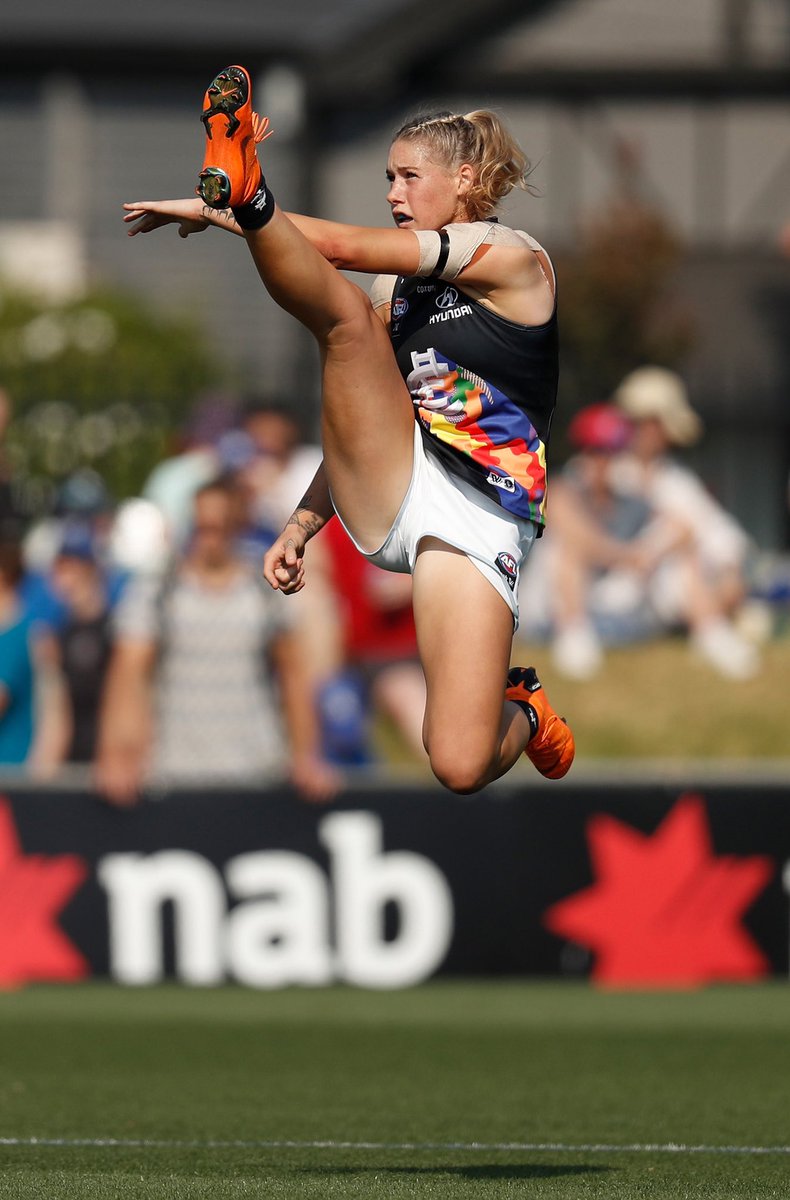
Nike advertisement for women in sport / breaking down stereotypes that women are weak

Survey + Results
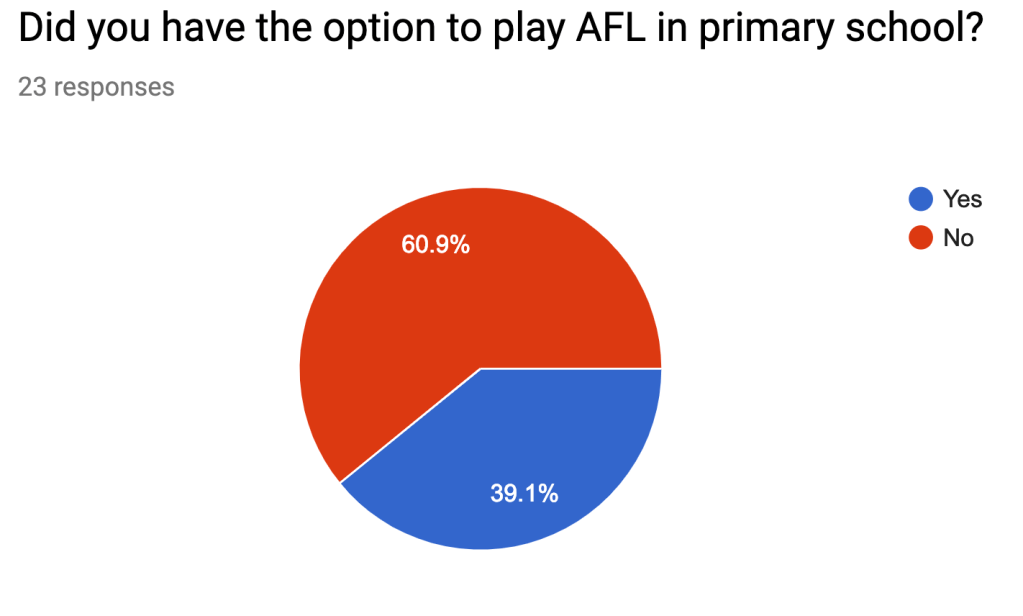
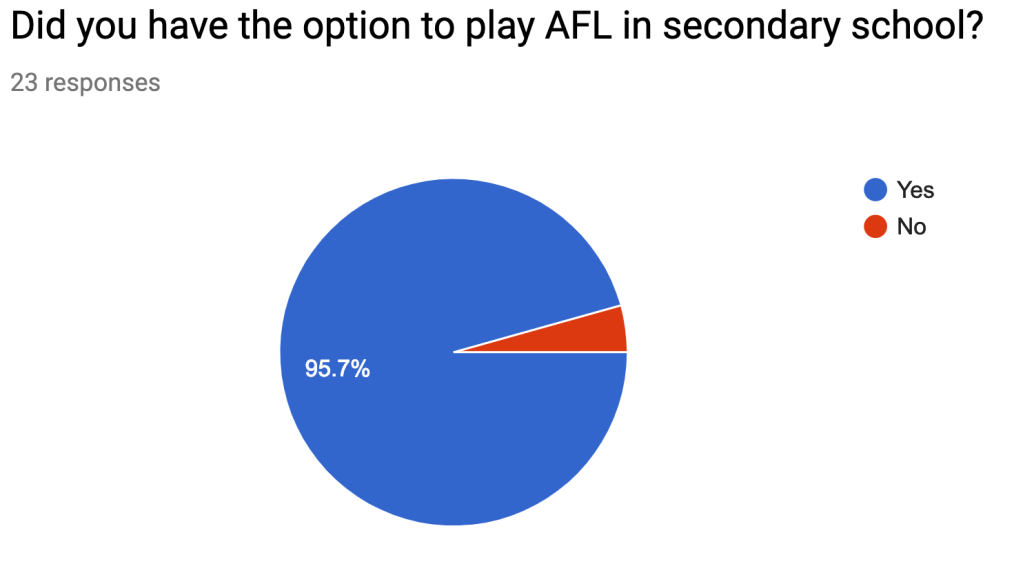
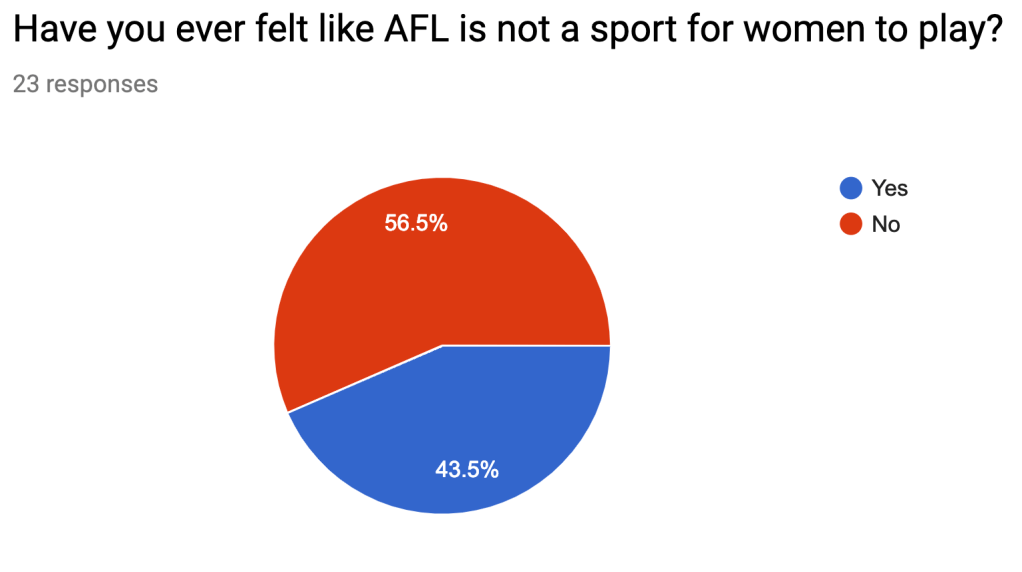
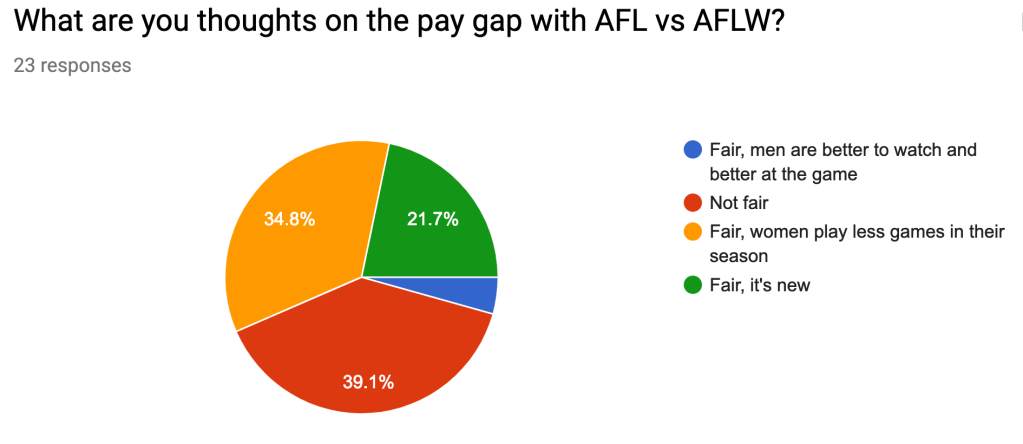
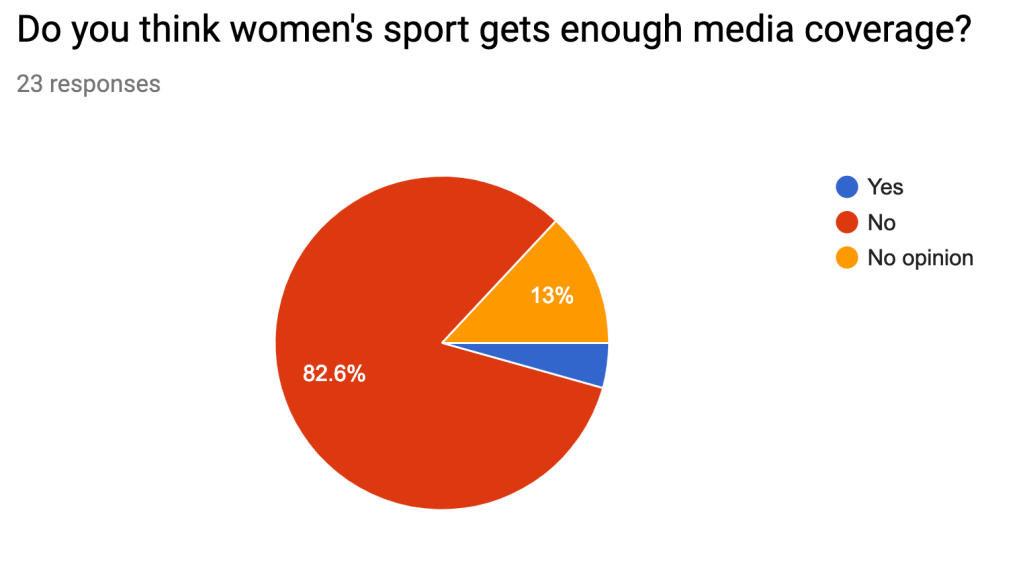
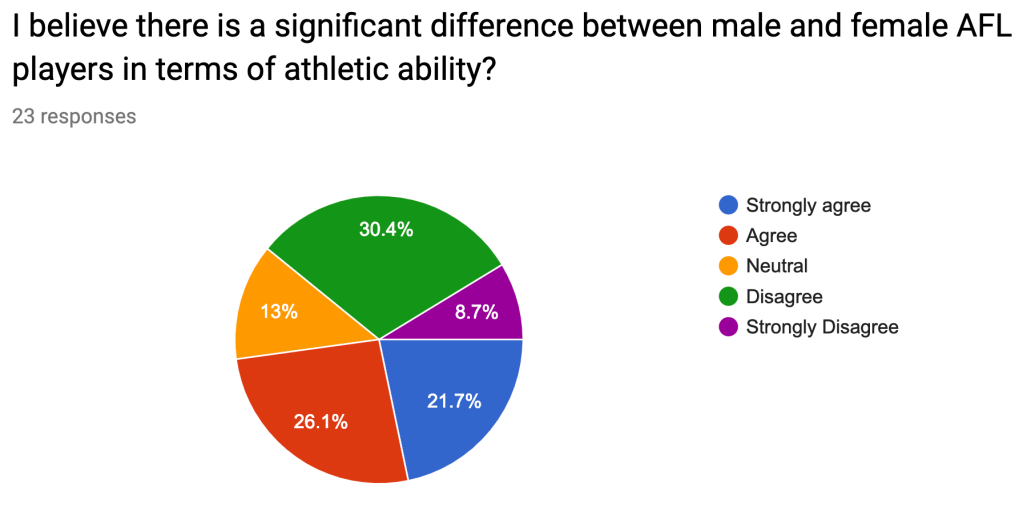
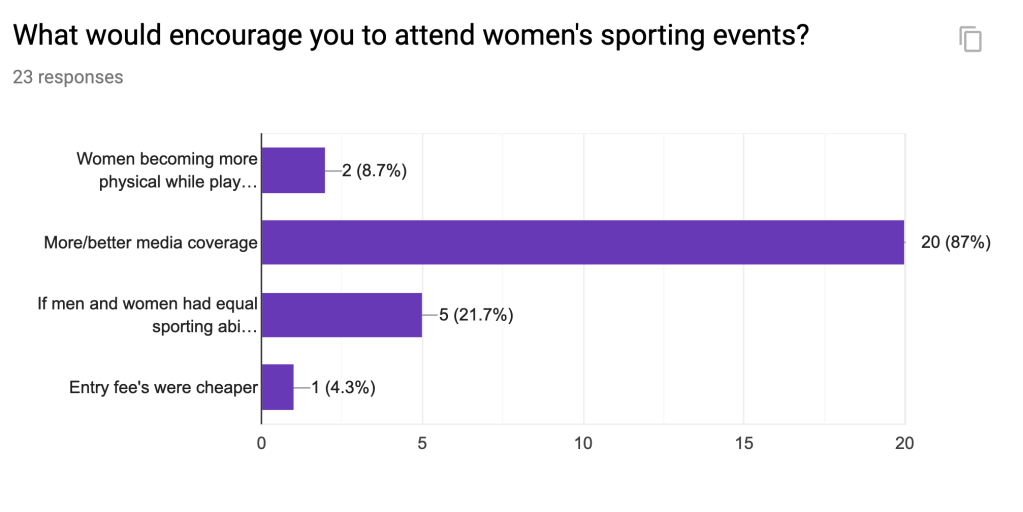
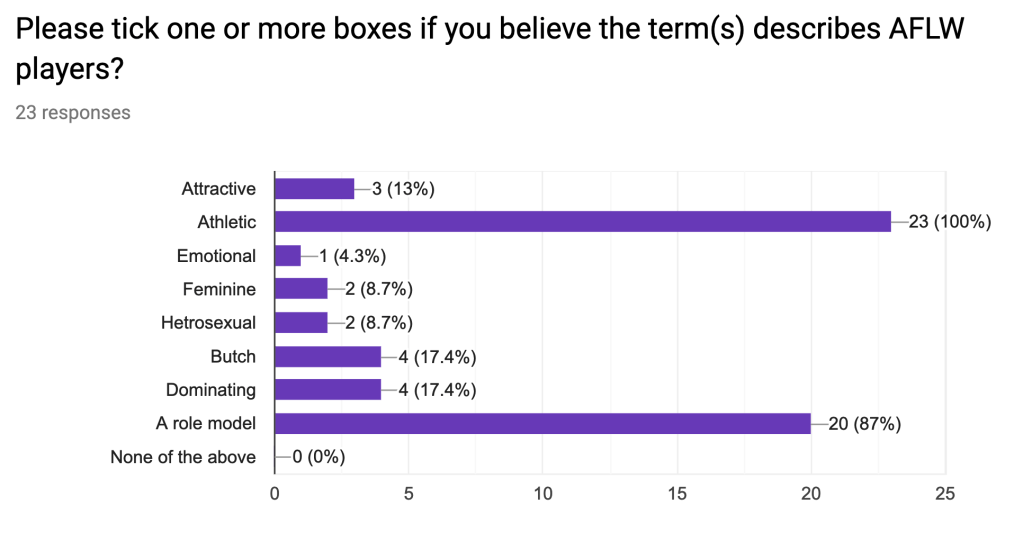
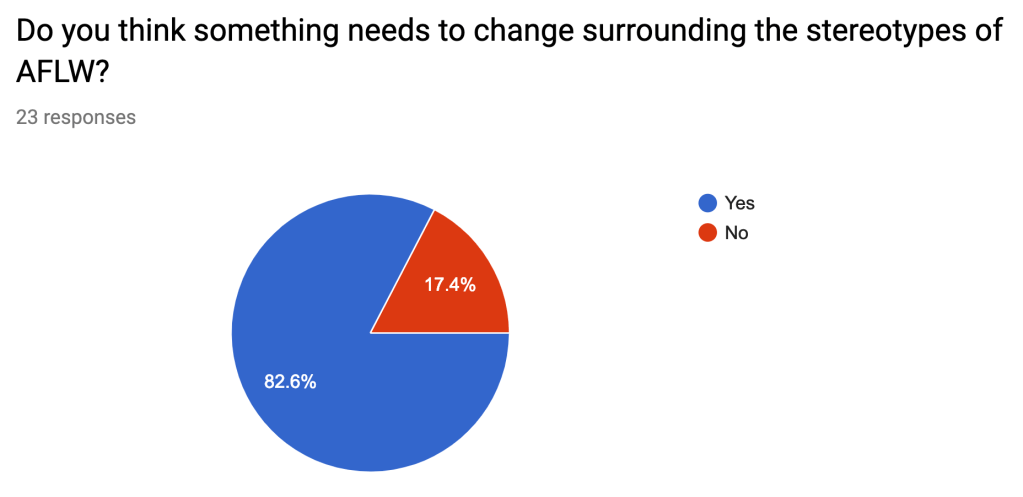
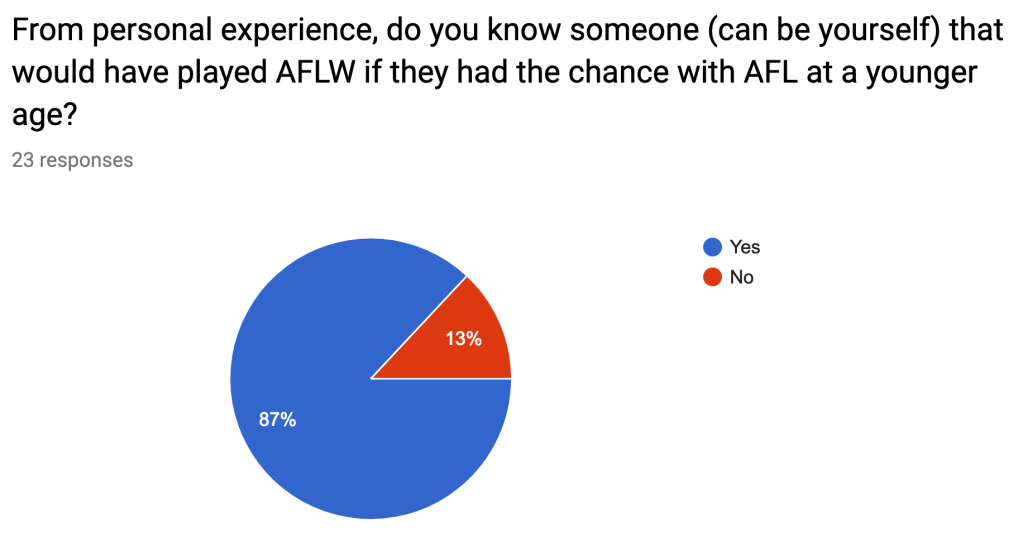
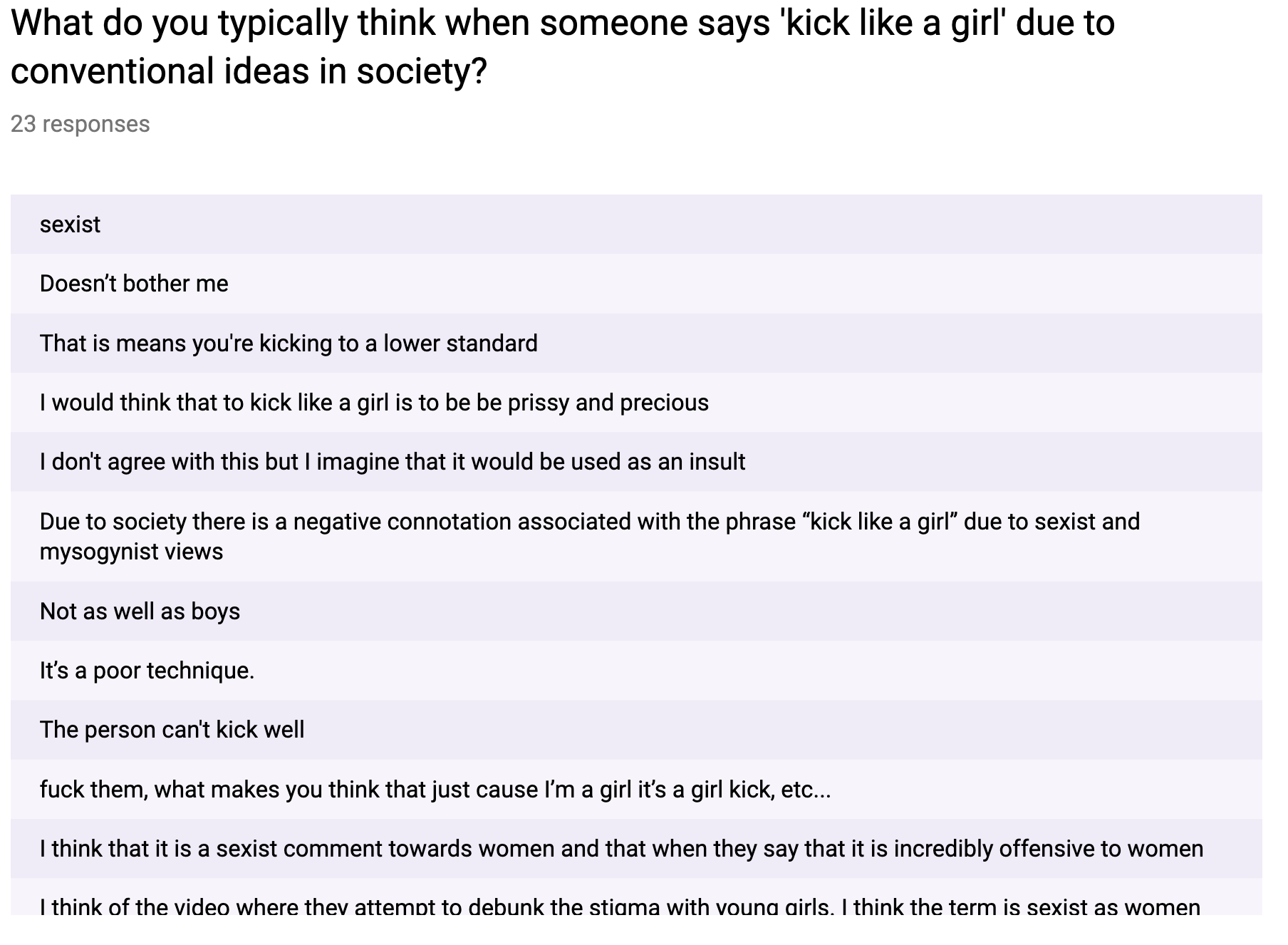
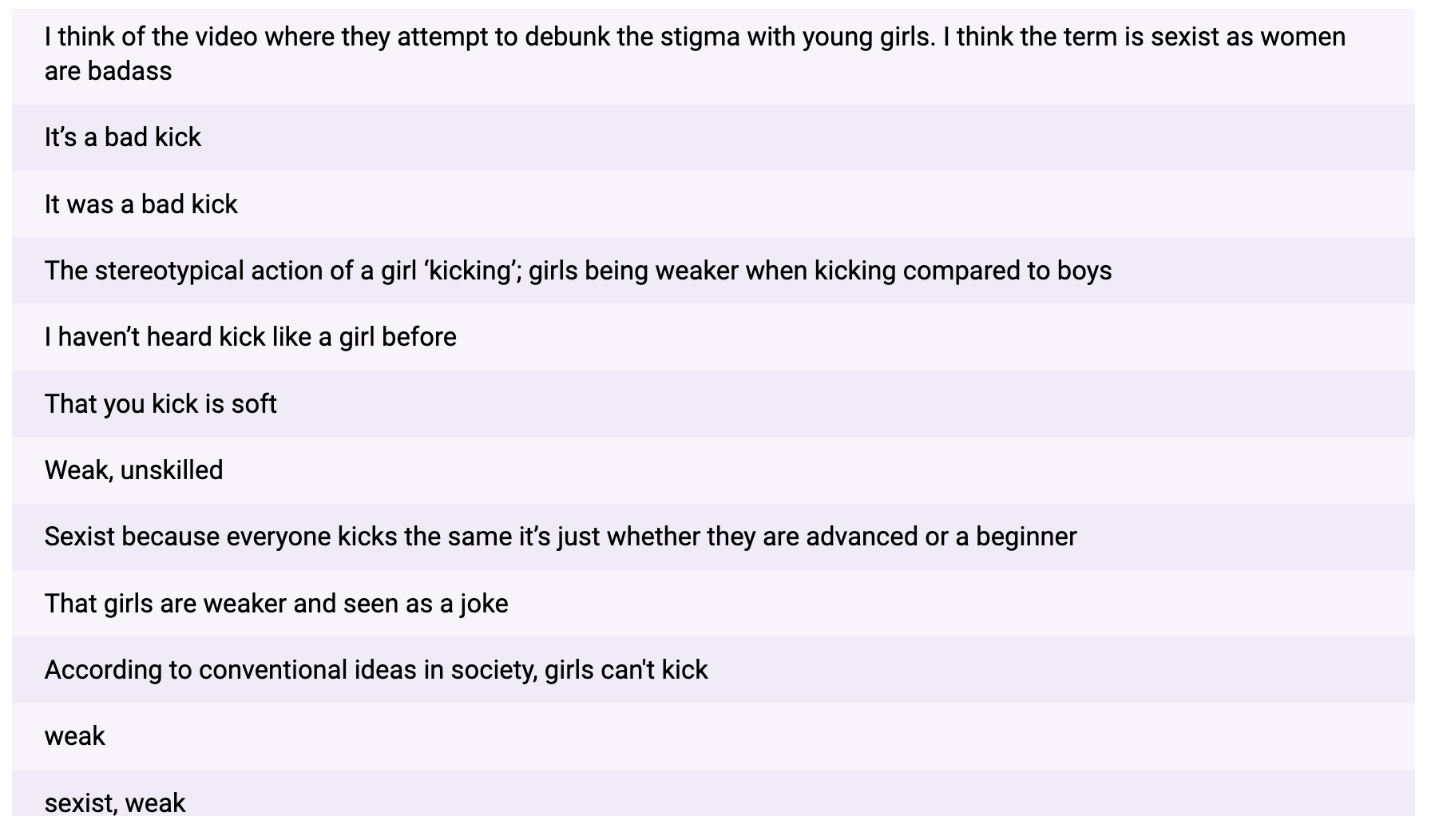
A survey was conducted as an aspect of research, this survey was for women of all ages to answer with questions regarding their involvements and opportunities in sport from a young age. We also questioned AFLW and the stereotypes surrounding this with the culture and players.
THE AFLW
“THE AFLW.” The Age [Melbourne, Vic.] 2018: 30. Web.
Give the game patience, trust and time to evolve
The AFLW is minutes old and the mother ship (the AFL) is suggesting a change in game style to improve scoring opportunity and maintain viewer interest (Sport, 7/2). This suggests there is a quick fix: discuss in the locker room and the show is improved for the next game. The AFLW is under-resourced, the athletes are part-time, it is an eight-week season, and coaches have limited time to bring a team together. The feeder systems are yet to mature, with teams recruiting cross-code athletes who do not necessarily have “game IQ”.
Learning does not happen overnight. Experience is key; it is underrated until you have it, and this relates to players, coaches, clubs and the AFL. Patience, trust and time are required for this professional game to evolve. As we have seen in other sports, the women’s game may give us something different and exciting that even the men can learn from.
Julia Walsh, Kew
The AFL should focus on the administration
I am outraged at the AFL’s “advice” to AFLW coaches regarding ways to improve the look of the game. It is yet another example of how the boys’ club runs within the AFL. I cannot imagine it making a similar suggestion to an AFL coach. “Clarko, we don’t like the way your coaching strategies result in such a one-sided game. We’re going to introduce a rule that makes it easier for other teams to beat you”.
AFL: let the coaches coach, the players play and you can worry about the administration. (Or at least sort out the second-rate, half-time entertainment at the Grand Final.)
Wendy Jolly, Seaford
We need to gain perspective on the game
The average score in the first season of VFL in 1897 (39 years after men started to play at the highest level) was 39 points. And VFA scores between 1858 and 1897 were routinely lower. The average score in the first AFLW season was 32 points. It is unreasonable to expect AFLW to be averaging anywhere near current AFL scores in season two.
I love watching AFLW and AFL. Women will attain the current skills we enjoy at AFL matches when girls are given the same encouragement, coaching and playing experiences as juniors as boys. And it will not take women 159 years to do it.
Jamin Moon, Eltham
Call it what it is: an amateur competition
Women enjoy playing football and so they should, as an outlet, but in reality AFLW is the standard of suburban, amateur competition. It would require a funding boost of $120 million for it to become a professional league.David Thomson, St Kilda
Women like sport, including women’s sport
Andrew Knight’s provocative comment that AFLW football receives too much media attention (Letters, 8/2) was sexist and offensive. Finally, talented female athletes are getting the coverage they deserve and their fans are responding. Why should their background stories be any less interesting than those of men’s? It is quite simple. Do not watch AFLW if you do not like it. Females make up more than half of our population. We like sport. We also like to watch women play sport. Why shouldn’t this include AFL football? We deserve a fair go.
Catherine Boal, Wangaratta
When will the “Men in Suits’ stop interfering?
Susan Alberti (Sport, 8/2) is dead right. AFLW has been a success story because of the fabulous women (and some men) who have created it, despite the efforts of the Men in Suits that are the AFL. The success has been driven at the club level.
I remember those fabulous Demons versus Bulldogs games just a few years ago, when spectators realised this was going to become something big. The AFL interfered even then. One game was not allowed to go to full-time because it would have meant the men’s game would start a few minutes late. Please, AFL bureaucrats and others, stop interfering.
Graham Hoult, Richmond
“We’re Not Simply Mirroring The Men’s Comp”: AFL Women’s Marketing Guru
With the Adelaide Crows crowned champions for the inaugural season of the AFL Women’s competition over the weekend, B&T sat down with the brains behind it all, Jemma Wong (pictured below), to reflect on the trials and tribulations she’s faced in building the brand.
The AFL Women’s competition has had great success in getting bums on seats for its inaugural season. Do you see this continuing next season, or will the ‘bliss period’ be over once the initial hype’s died down?
It’s been an incredible first season. Naturally, there is a lot of energy and emotion wrapped around year one and every milestone to date has been history-making, but AFL Women’s is more than just novelty. This ‘movement’ has been 100 years in the making, built by the pioneers of the game who never gave up and created from the demand of 350,000 girls and women playing the game at a grassroots level.
We know the interest will build from here because of the product itself. It packs power. It’s footy at its best – it’s compelling, entertaining and unpredictable live sport that has captured the imagination of fans all across the country. While it’s certainly early days, the appetite and passion from fans has proven that AFLW can hold its own ground.
There’s already been a surge of interest in female participation off the back of our first season. The Victorian Amateur League will play its inaugural women’s competition this year with 40 teams, which is an extraordinary result. Our next phase will be sustaining the interest we’ve ignited over the last eight weeks throughout the off-season and managing the expectations as we kick off for the 2018 season.
How easy/hard has it been to attract sponsors to the AFLW?
In approaching brands to partner with AFLW, we found that we couldn’t sell based off traditional sponsorship metrics given there was no historic broadcast or attendance data. Our position in market was to align with like-minded brands who wanted to tell a story about equality. What was fantastic was that we were able to partner with a mix of existing AFL Partners such as NAB (the premier naming rights partner of AFLW) and also new brands that had previously not been involved with the code – Chemist Warehouse and Kellogg’s. Our partners have been extremely supportive and understanding of the challenges we face building a competition and brand from scratch, and like us, they see the mass potential of AFLW to grow the game.
Is the onus on female brands to support the competition through sponsorship?
This is about normalising and demystifying women in sport as much as it is about successfully growing AFL. For that to happen, we need a range of brands from a diverse mix of categories to help us drive the agenda.
When you reflect on the fact that women are the most influential consumer audience carrying the majority purchasing power in Australian households, it becomes more important to work with brands that tap into and respond to that insight, rather than searching for interest from ‘female brands’.
Do you think some female-skewed brands are put off by sponsoring contact sports such as AFL?
This really depends on the brand’s values and who their customers are. I do think it’s limiting to assume that female-driven brands or female customers wouldn’t see benefit in associating with an elite contact sport, particularly when it promotes values such as empowerment, confidence and women conquering their limits.
We celebrate the physicality, athleticism and the energy of AFLW. These qualities are part of our DNA and part of the reason why so many girls want to pick up a footy and play. I’d invite all brands, whether they are female-skewed or male-skewed, to be curious about the motivators and barriers for playing the game, and to think about the type of role models and heroes their audiences need to start seeing.
How are you trying convince more girls to go out and kick a footy? How hard is it trying to change the perceptions around women playing contact sports like AFL?
We want AFLW to be a gateway for participation. This comes down to visibility and opportunity – young girls need to see their potential pathway to the top on TV screens, on the back of footy jumpers, in headlines and on social feeds. They need to feel empowered and inspired by their place in the game, alongside having the right local or state program on offer.
We’ve spent the last six months telling stories of our AFLW players and working with different types of content creators to show the power of football and belonging in an empowering and real way. This is all part of breaking the stigma and stereotypes surrounding women in sport. Cultural shifts take time, but if we look at the number of young boys and girls wearing AFLW player jumpers over the weekend, we know it’s moving in the right direction.
What’s the biggest challenge that the competition faces going forward?
From a marketing perspective, we need to ensure we continue to tell insightful and compelling stories about AFLW that stretch across 365 days of the year – not just during the competition. We need to focus on brand building in community footy to drive interest in the next generation of talent, and to focus on the total experience of all audiences across broadcast, content, digital platforms. We need to keep our edge by continuing to be brave in how we make decisions for the sustainable growth of AFLW and not simply mirroring the men’s competition.““We’re Not Simply Mirroring The Men’s Comp”: AFL Women’s Marketing Guru.” B & T Weekly [Surry Hills] 2017: B & T Weekly, Mar 28, 2017. Web.
Jemma Wong will feature as a speaker at this year’s Ministry of Sports Marketing event on Tuesday 18 July in Sydney. To find out more about the event or purchase tickets, click here. Early bird tickets are on sale now!

https://www.kelloggs.com.au/en_AU/articles/special-k-powering-you.html
NAB AFL WOMEN’S PARTNERSHIP
An incentive of NAB- Creating a rising star award, encouraging improvement and something to motivate women in AFL.
 Challenging Stereotypes in Female Sport